Most Common Violations Found in Michigan Assisted Living Homes 2026
A small study on the most common violations found in Michigan Adult Foster Care (AFC) and Homes for the Aged (HFA) and my opinion on why it has seemingly got so bad.
Carly White - September 3, 2026
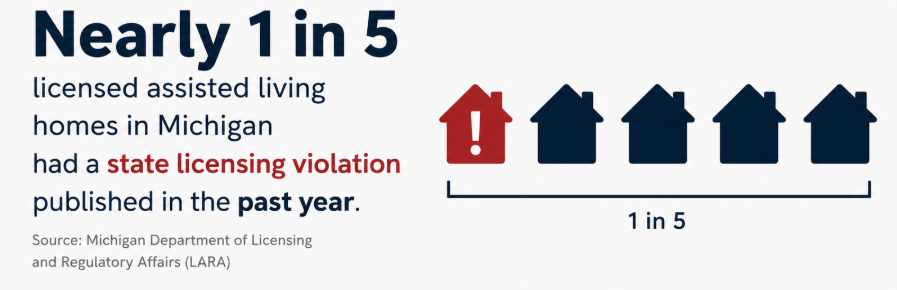
Nearly 1 in 5 licensed assisted living homes in Michigan had a state licensing violation published just in the past year.
Click here to view what the specific violations were.
I recently went through a large number of Michigan Adult Foster Care (AFC) and Home for the Aged (HFA) licensing violations from the past year to get a better idea of what problems are happening most often in care homes.
I knew there would be violations, but I did not expect the numbers to be quite as high as they were.
That obviously does not mean that 1 in 5 homes are terrible places to live. Violations vary in seriousness. A missing signature on a document is very different from giving someone the wrong medication, failing to supervise a resident, or abuse.
Medication Problems Were the Most Common
The most common violations I found were related to medications.
| Medication Related Violations | |
|---|---|
| Physician orders or medication instructions not followed or unclear | 221 |
| Medication Administration Record or documentation errors | 215 |
| Wrong dose, wrong time, or wrong medication | 171 |
| Medications missed, not given, or unavailable | 121 |
This was probably the biggest surprise to me.
Medication management is one of the most important responsibilities a care home has, and there should be clear procedures in place to make sure medications are given correctly, documented properly, and never missed.
Always ask the home exactly how they handle medications, who is responsible, how staff are trained, and what happens if a dose is missed or there is an error. Their process should be clear, organized, and easy to explain.
Care Plans Were a Big Problem
There were approximately 126 violations involving resident care plans not being followed and another 71 involving assessments or care plans that were incomplete or not properly updated.
A care plan is one of the very first and most important things a home needs to establish for a resident. It lays out exactly what that person needs, what staff should be watching for, and how their care is supposed to be provided. For care plans to be incomplete, outdated, or not followed at all is a huge red flag to me because that is basically the foundation of the resident's care.
Ask the home how they create, review, and update each resident’s care or service plan, and how staff are made aware of any changes. In Michigan, both AFC and HFA homes are required to review these plans at least annually, and sooner when a resident’s needs change. A good home should be able to clearly explain how they keep these plans current and make sure staff are actually following them.
Supervision and Resident Safety Were Another Major Problem
Some of the other common violations included:
| Safety Related Violations | |
|---|---|
| Unsafe or poorly maintained premises | 102 |
| Inadequate supervision leading to falls, wandering, elopement, etc. | 91 |
| Failure to protect a resident from harm or another resident | 89 |
| Failure to get timely medical help or call 911 | 71 |
| Not enough staff or residents left without required supervision | 53 |
| Accepting or keeping residents whose needs could not safely be met | 52 |
These violations are all obviously very troubling, but the failure to call for medical help is one of the most serious breakdowns in care to me. It makes me wonder why staff are hesitating to call 911 in the first place. Are they afraid of getting in trouble, trying to avoid attention on the facility, poorly trained, or just unsure of what to do? In a true emergency, none of those things come before getting the resident help.
Ask the home what happens after a fall, hospital visit, wandering incident, or major change in condition. A good home should be able to explain how they reassess the resident, change supervision if needed, and decide whether they can still safely meet that person’s needs.
Mistreatment of Residents
| Physical or verbal abuse, rough treatment, or inappropriate force | 93 |
| Failure to protect a resident from harm or another resident | 89 |
| Dignity, privacy, or respect violations | 69 |
| Hygiene or personal-care needs not being met | 57 |
| Residents left soiled or not receiving adequate bathing or hygiene | 14 |
| Exploitation or inappropriate staff-resident relationships | 14 |
These violations are some of the hardest to read because they deal directly with how residents are being treated. Abuse, rough treatment, poor hygiene, lack of privacy, or failing to protect a resident should never become normal in a care home.
Ask a home how they handle complaints, how residents can report concerns, and what they do when an employee is accused of mistreating someone. Families should also pay attention to how staff speak to residents and whether residents appear clean, comfortable, and respected.
Common Offenses in Michigan
| Common Offense | Approx. Number of Violations in Michigan in the Past Year (2025-26) |
|---|---|
| Physician orders or medication instructions not followed / unclear | 221 |
| Medication Administration Record/documentation errors | 215 |
| Wrong dose, wrong time, or wrong medication | 171 |
| Resident care plan or medical instructions not followed | 126 |
| Medications missed, not given, or unavailable | 121 |
| Unsafe or poorly maintained premises | 102 |
| Physical/verbal abuse, rough treatment, or inappropriate force | 93 |
| Inadequate supervision leading to falls, wandering, elopement, etc. | 91 |
| Failure to protect a resident from harm or another resident | 89 |
| Failure to get timely medical help or call 911 | 71 |
| Assessment or care plan incomplete or not updated | 71 |
| Staff missing required training | 69 |
| Dignity, privacy, or respect violations | 69 |
| Missing/incomplete employee records, background checks, health screenings, etc. | 62 |
| Unqualified staff or administrator problems | 57 |
| Hygiene or personal-care needs not met | 57 |
| Not enough staff or residents left without required supervision | 53 |
| Accepting or keeping residents whose needs could not safely be met | 52 |
| Missing required signatures or approvals | 49 |
| Fire, smoke detector, or emergency preparedness problems | 45 |
| Improper medication storage or residents gaining access to medication | 41 |
| Inadequate meals, nutrition, or inappropriate food | 35 |
| Blocked or unsafe exits / egress | 32 |
| Menu or meal documentation deficiencies | 29 |
| Required records missing or incomplete | 29 |
| License, permit, posting, or other licensing requirement problems | 24 |
| Improper food storage, spoiled food, or sanitation problems | 23 |
| Resident money not properly safeguarded or accounted for | 20 |
| Improper or prohibited restraints / physical interventions | 19 |
| Failure to comply or cooperate with licensing requirements | 19 |
| Important risks, supervision requirements, or interventions left out of plan | 18 |
| Special diets not followed | 17 |
| Behavior plans or interventions not followed | 16 |
| Incidents not reported or notifications not made as required | 15 |
| Too many residents or occupants for licensed capacity | 15 |
| Exploitation or inappropriate staff-resident relationships | 14 |
| Residents left soiled or inadequate bathing/hygiene | 14 |
| Improper use of rails, belts, positioning devices, or other assistive devices | 13 |
| Dirty or unsanitary rooms, bathrooms, or home conditions | 13 |
| Pest problems such as mice, bedbugs, lice, or roaches | 13 |
| Chemicals or equipment stored unsafely | 12 |
| Dirty linens, laundry, or bedding problems | 11 |
| Resident registers or required documentation not kept current | 9 |
| Resident valuables or property missing or mishandled | 7 |
| Unsafe or improper transportation | 3 |
| Required recreation or activities not provided | 2 |
How Did It Get This Bad? - My Opinion
I think there are a lot of overlapping factors that have led to the regular violations we see in assisted living homes. I could probably go on forever about all of them, but let’s just get to the meat and potatoes.
1. Owners have become too far removed from the actual care happening in the home.
When the owner of an assisted living facility is completely removed from the day-to-day care, it can become a recipe for major oversights when real problems happen.
Who is reporting the problem? (if they even report) Who are they reporting it to? Does that report actually make it all the way up the chain? And once it does, who is making sure something is actually done about it?
Owners of larger facilities may only see the version of the facility that gets reported back to them. A spreadsheet can say staffing is covered, tasks are being completed, and everything is running smoothly, while the actual day-to-day experience inside the home tells a very different story. The farther ownership gets from the residents and caregivers, the easier it becomes for serious problems to be filtered, minimized, or missed completely.
This definitely is not the ownership model of every care home. There are plenty of owners who are very involved. But we are seeing more of a model where one company or owner controls hundreds of beds across multiple facilities. At some point, the people making the biggest decisions can become very disconnected from the residents and caregivers those decisions actually affect.
2. Families often don’t have enough good alternatives.
There simply are not enough quality care-home beds for the number of people who need them.
That means families sometimes end up staying with a home they are unhappy with because moving their loved one is not as simple as finding another place down the street.
And think about what happens when a very large facility with hundreds of residents develops serious enough problems that LARA has to consider shutting it down. Where are those hundreds of residents supposed to go?
When there is already a shortage of available beds, shutting down a bad facility can create an entirely different crisis. That puts everyone in a difficult position and can allow problems to continue longer than they ever should.
3. They are asking caregivers to do an incredibly important job without always giving them what they need to succeed.
A lot of homes put caregivers in situations where even a great employee is going to struggle. Too many residents assigned to one caregiver, long hours, low pay, unrealistic workloads, and policies that may look good on paper but do not always make sense for the people actually living in the home.
Caregivers are the people providing the hands-on care every single day. If they are constantly overworked, understaffed, underpaid, or unsupported, eventually the quality of care is going to suffer. Good employees burn out, performance drops, and many eventually leave.
That creates another problem: high turnover and rushed training. Residents end up being cared for by people who may barely know them, their routines, their personalities, or what to watch for when something is wrong. New employees may also be pushed onto the floor before they have received enough real-world training for things like falls, medications, dementia behaviors, emergencies, and resident rights.
You can have all the policies and procedures in the world, but if the person actually providing the care does not have enough time, support, training, or resources to do the job properly, the residents are ultimately the ones who pay the price.
4. Profit and efficiency can slowly start taking priority over quality of care.
Care homes are businesses, and of course they need to make money to stay open. But problems start when every decision becomes about cutting costs instead of improving care.
Every extra caregiver, better meal, activity, repair, or training session costs money. If a company keeps trimming those things to improve the bottom line, eventually residents may still technically be receiving care, but the quality of that care can become the bare minimum.
I do not think making a profit is the problem. The problem is when saving money starts becoming more important than the people living in the home.
5. Poor care can slowly become “normal.”
This may be one of the biggest problems of all.
When a facility is short-staffed every day, eventually being short-staffed stops feeling like an emergency. When residents regularly wait too long for help, paperwork is always behind, meals are rushed or forgotten, and important tasks are constantly being pushed off, people can slowly start accepting it as just the way things are.
That is how small problems can turn into much bigger ones. If nobody stops and says, “This is not acceptable,” the standard keeps getting lower and lower until something serious happens.
I’m curious if anyone has any other thoughts or experiences as to why care has gotten so bad so share your comments below.